Honeycomb cellular shades
The insulating one. Air trapped in the honeycomb cells slows heat moving through the glass, which matters on old windows and in west-facing rooms. Available light-filtering through full blackout.
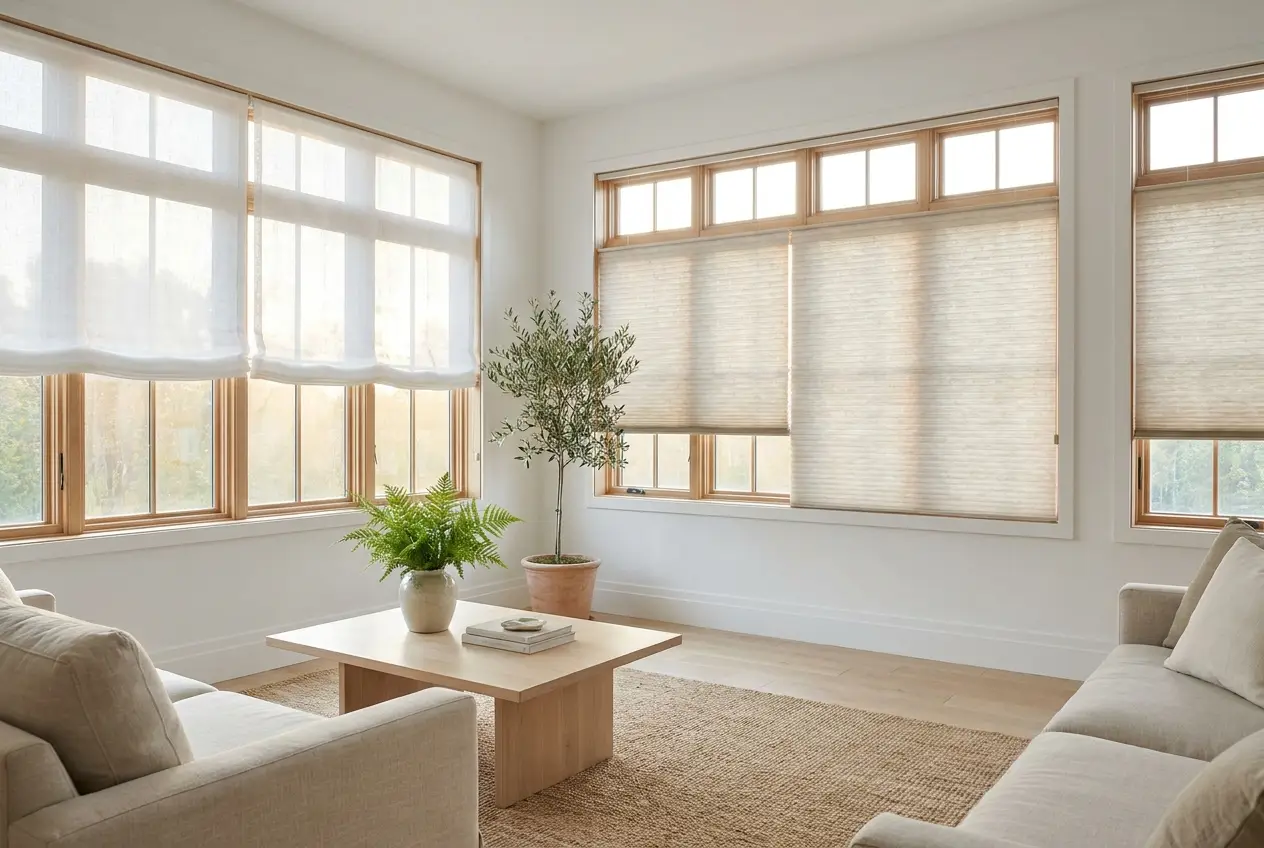
Shades, every kind
Shades are the most flexible thing we hang — the same window can be soft daylight, glare-free screen light, or dead black at 2pm, depending only on what we put in it. Hundreds of fabrics, and one honest conversation about which one you actually want.
Start here
People usually come to us asking for a type of shade. Almost always the better first question is what the room is doing wrong: too much glare on the television, too much heat in the afternoon, a bedroom that goes bright at five in the morning, or a front window that feels exposed after dark.
Answer that and the shade type mostly picks itself. A solar screen kills glare while keeping the view. A blackout cellular fixes the bedroom. A top-down/bottom-up cellular gives you privacy at the sidewalk without giving up the sky. Layered dual shades let you switch between two of those in the same window.
We bring the fabric books to your house and hold them against your actual glass in your actual light, because a swatch under showroom lighting tells you very little about how it will read at four in the afternoon in your living room.
The range
From sheer through to full blackout, in cordless, motorized and top-down/bottom-up configurations.
The insulating one. Air trapped in the honeycomb cells slows heat moving through the glass, which matters on old windows and in west-facing rooms. Available light-filtering through full blackout.
The clean one — a single flat fabric on a tidy roll, with an exposed or fully enclosed cassette. The most contemporary look we hang and the easiest to motorize.
Woven screen with an open weave that cuts glare and UV while you can still see out. This is the answer for a room where the view is the point and the afternoon sun is the problem.
Fabric that stacks in folds as it lifts. Reads as drapery rather than as hardware, so it softens rooms full of hard surfaces. Available lined and blackout-lined.
Fabric vanes floating between two sheers, so you can tilt for privacy without losing the daylight — the diffuse, gallery-like light people usually mean when they say a room feels expensive.
Bamboo, reed, jute and grasses. Texture and warmth, with an optional privacy liner for bedrooms — the natural weave alone lets more through than most people expect.
Two fabrics in one headrail, usually a solar screen and a blackout. Daytime glare control and night-time privacy from a single window, without hanging two separate shades.
Cords, kids and pets
We quote cordless lift as standard on anything going into a home with young children or pets, and we will say so plainly if a cheaper corded option is the one you are looking at. A looped cord in a child's room is not a trade-off worth the saving.
Cordless, wand-tilt and motorized options are available across nearly the whole shade range. On tall two-story windows motorization stops being a luxury and starts being the only sane way to operate the shade at all — that is covered on the motorization page.
The range
They do genuinely different jobs. Each page explains where that one is the right answer and where it is not.
Questions
Cellular shades are built from honeycomb cells that trap air, so they insulate — a real difference on old glass and in west-facing rooms. Roller shades are a single flat fabric on a roll: cleaner and more contemporary, easier to motorize, but with no insulating layer. If the room is uncomfortable, choose cellular. If it's about the look, choose roller.
Blackout-lined cellular and blackout roller shades both get a bedroom genuinely dark. The catch nobody mentions is the light that leaks around the edges rather than through the fabric — so if total darkness is the goal, we'll spec a side channel or an outside mount that overlaps the frame. Ask us for that at the measure; it's much harder to add afterwards.
Yes — that's the whole point of them. The open weave cuts glare and UV while keeping the view, and the tighter the weave, the more glare it stops and the less you see. During the day people outside see very little; after dark, with lights on inside, that reverses, so solar screens aren't a privacy product on their own. That's usually where a layered dual shade earns its keep.
In a home with young children or pets, yes, without hesitation — a looped cord isn't a risk worth the saving, and we quote cordless as standard there. Elsewhere it's a preference: cordless is cleaner to look at and there's nothing to tangle, but corded lift costs less on a large window.
Hundreds, across Graber, Norman and our fabric workrooms. That's more of a problem than a benefit in a catalogue, which is why we bring the books to your home and hold them against your own glass in your own light — a swatch under showroom lighting tells you almost nothing about four in the afternoon in your living room.
Free & no-obligation
Tell us a little about your project and we'll call to set up your free in-home consultation — usually within one business day. Prefer to talk now? Call (610) 883-9063.
Windows still bare? The consultation is free and the coffee's on you.