Painted & stained wood shutters
Basswood and poplar in a full paint and stain range. The lightest option per square foot, which matters on wide openings — a tall wooden panel stays true where a heavy one starts to sag on its hinges.
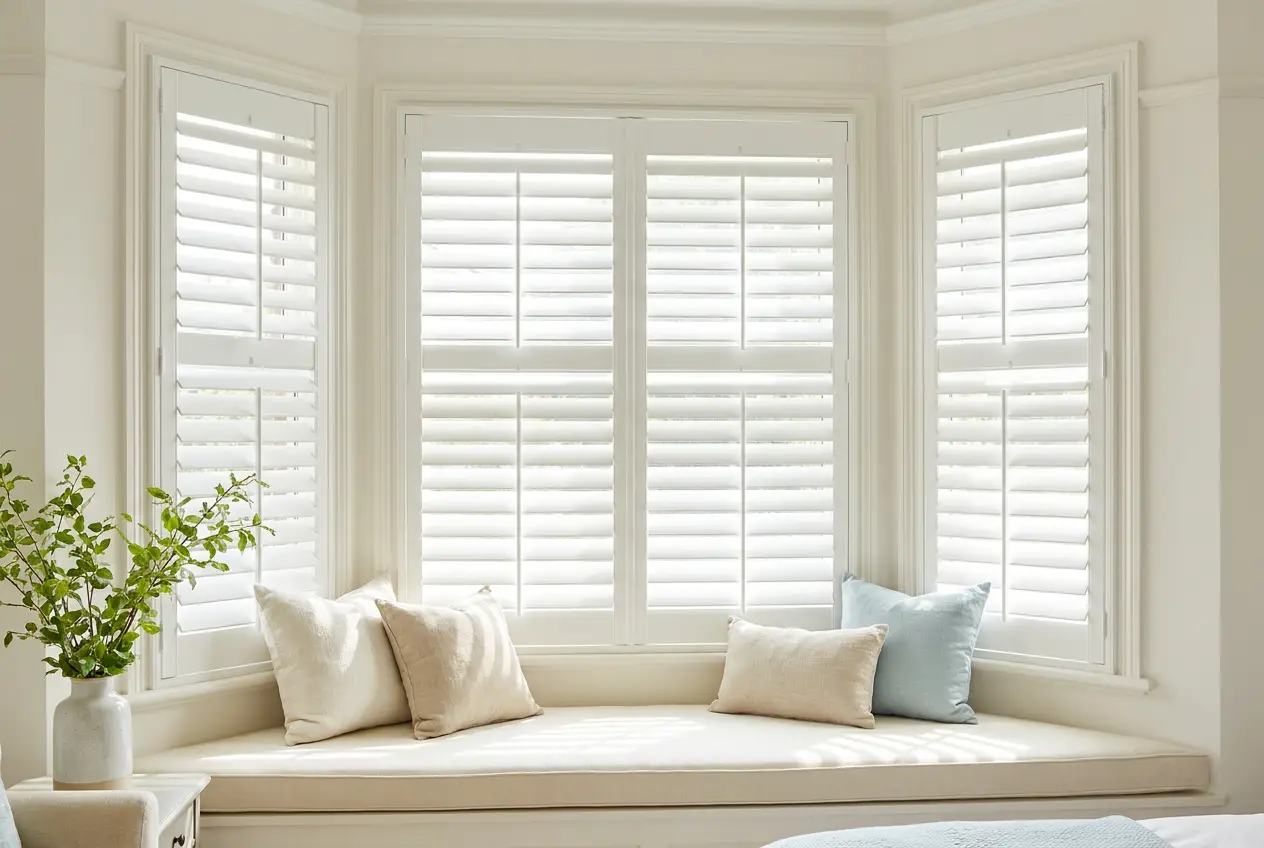
Plantation & interior shutters
Shutters aren't a covering, they're joinery. Hardwood and composite louvers built to your exact opening, hung on your frame, and finished so they read as part of the room rather than something added to it.
Why shutters
Most window treatments are a running cost. You buy them, they fade, they fray, and in eight years you buy them again. Shutters break that cycle — they are the only treatment we sell that reliably outlives the decor around it, and the only one that appraisers and buyers treat as part of the house.
That is also why we quote them honestly rather than cheaply. A shutter is a fitted piece of carpentry: the frame has to match your opening, the louvers have to clear the sash, and the whole thing has to still close square after a decade of Pennsylvania humidity. Getting that right takes a real measure, not a tape and a guess.
We install hardwood and composite shutters from Norman Window Fashions across Chester County, the Main Line, Delaware County and northern Delaware — from 1840s stone colonials with openings that are square nowhere, to brand-new Middletown builds where every window is identical and the install is done in a morning.
The range
Which one is right depends less on taste than on the window: what it is made of, how much moisture it sees, and how far the sash sticks out.
Basswood and poplar in a full paint and stain range. The lightest option per square foot, which matters on wide openings — a tall wooden panel stays true where a heavy one starts to sag on its hinges.
An engineered core with a factory finish that will not swell, warp or yellow. This is what goes in bathrooms, kitchens and any window that gets afternoon sun all summer.
One continuous run of louvers with an optional mid-rail so the top and bottom halves tilt separately. The default for most rooms, and the cleanest look from the street.
Louvers on the bottom half of the window, bare glass above. Privacy at eye level from the sidewalk while the room keeps its daylight — the classic answer for a front room on a close street.
Arched tops, octagons, angled rakes on a gable end. These are template-measured rather than tape-measured, and are exactly the sort of window a big-box special order will decline.
Track-hung panels for patio doors and wide openings, so the shutter folds or slides clear of the door instead of fighting it.
The part that goes wrong elsewhere
Nearly every shutter complaint we are called out to fix on someone else's install traces back to the same thing: the opening was measured as if it were square, and it wasn't. Panels then bind, gaps open at one corner, and the louvers stop closing flat against the light.
We measure every opening at multiple points, note which way it is out, and build the frame to the reality rather than the ideal. That is unglamorous and it is the whole job. It is also why fit is our problem and never yours — if it does not close right, we come back.
Installation is ours end to end. We hang the frame, adjust the louver tension, walk you through the tilt, and take the packaging with us.
The range
Hardwood, composite, cafe height and full height — all built to your measured opening.
Questions
Neither is better overall — they answer different rooms. Hardwood is lighter, which keeps wide panels hanging true, and takes a stain that composite can't match. Composite won't swell or warp, so it wins anywhere with steam or heavy sun: bathrooms, kitchens, and west-facing rooms. On a free in-home consultation we'll tell you which we'd put in each window, and why.
Shutters are quoted per opening after a free in-home measure, because the price is driven by the size and shape of the window rather than by a per-window flat rate. Specialty shapes and bypass tracks cost more than standard rectangles. Current promotions run up to 30% off, and the consultation and quote are always free and no-obligation.
They're the window treatment most likely to be treated as part of the house rather than as contents, because they're fitted joinery attached to the frame. That's also why they typically stay with a sale. We won't put a number on your appraisal — that's your realtor's call — but of everything we install, shutters are the one buyers notice from the curb.
Most orders are made and installed within a few weeks of the measure, with specialty shapes taking longer because they're built from a template. We'll give you a real date at the quote, not a range — and if the manufacturer slips, you hear it from us rather than finding out on install day.
Yes, and it's routine work for us. Arches, octagons, and the angled rake on a gable end all get template-measured rather than tape-measured. These are the windows a big-box special order will usually decline outright.
Free & no-obligation
Tell us a little about your project and we'll call to set up your free in-home consultation — usually within one business day. Prefer to talk now? Call (610) 883-9063.
Windows still bare? The consultation is free and the coffee's on you.